A brand’s value goes far beyond its logo in the automotive world. Consumer perceptions, resale values, and local market preferences shape how much consumers are willing to pay. Understanding the interplay between brand and brand value and residual values is crucial for OEMs, banks, insurance companies, and other industry stakeholders. By recognising this dynamic, stakeholders can better navigate market trends, adjust strategies, and optimise decision-making across the value chain.
At RedBook, we rely on data-driven insights to shed light on the actual influence of brand recognition on vehicle values. The Marque Equity Index (MEI) captures the “essence” of a brand’s pricing power in the marketplace, clearly understanding how consumer ow consumer perceptions and brand identities influence used vehicle prices. With so many factors influencing the market, it can be challenging to clearly understand the value a particular vehicle offers compared to others.
RedBook’s Marque Equity Index tackles this challenge by using Australia’s most accurate vehicle valuations to deliver a clear, concise metric that reflects a brand’s or vehicle’s pricing strength.
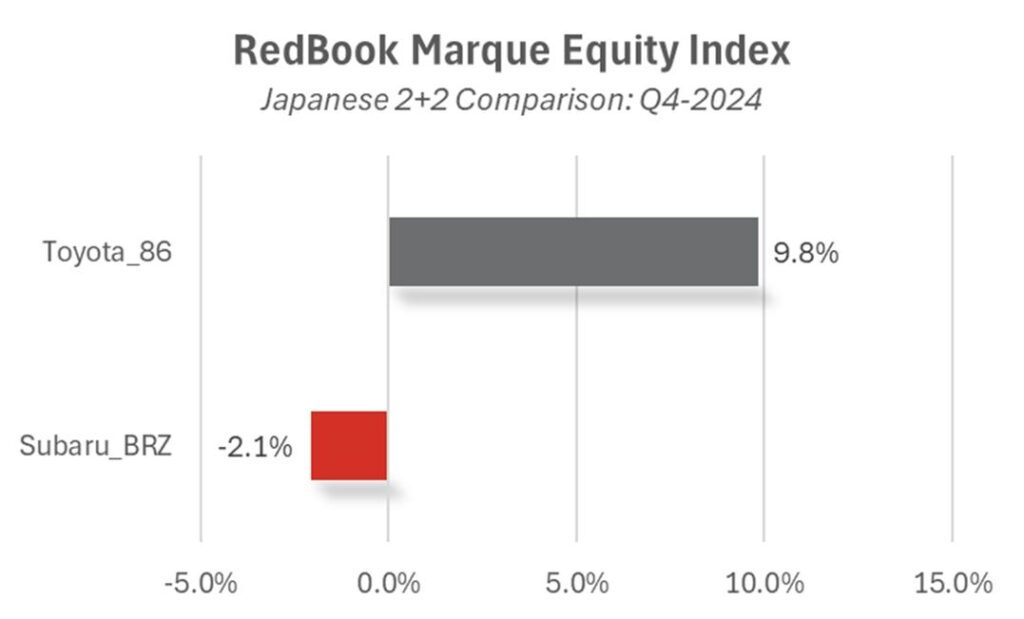
A simple use case of MEI is comparing co-developed vehicles from different brands. Despite being built to similar specifications, cars from various manufacturers can exhibit varying resale values due to brand strength, consumer perception, and market positioning. A prime example is the Toyota 86 and Subaru BRZ, two vehicles that share much of their engineering but are marketed differently by their respective brands.
From a specification standpoint, the Toyota 86 and Subaru BRZ are nearly identical. However, when we look at the MEI data, there is a notable difference in their performance in the used car market. The Toyota 86 has an MEI of 9.8%, while the Subaru BRZ lags with an MEI of -2.1%. This 12-percentage gap means that all else being equal, the Toyota 86 will hold a significant premium in the used car market.
This example demonstrates how MEI can be leveraged to understand how brand perception can influence consumer behaviour, even when the products are nearly indistinguishable in specifications. By tracking MEI scores, our customers can better understand how brand strength affects the long-term value retention of vehicles in the market.
MEI is a valuable tool for used vehicle buyers and sellers to understand pricing trends, for automotive product planners to align new vehicle pricing with consumer perceptions, and for industry professionals to assess how brand image impacts or aligns with overall messaging and objectives. Backed by over 70 years of historical data and detailed insights from RedBook, MEI is an essential tool for tracking and managing the performance of all brands and segments in today’s market.
Here are the top and bottom five mainstream brands based on MEI and the factors that may explain these rankings.
At the bottom end, brands like Chery, LDV, and GWM are ranked lower, indicating they are currently under pressure relative to their competitors. These brands face challenges such as limited consumer recognition, concerns about vehicle durability, and a lack of market presence. While their vehicles are competitively priced, they often struggle to maintain demand in the used-car market, which impacts their MEI score.
On the other hand, established names like Toyota, Suzuki, and Volkswagen perform strongly in the MEI rankings. These positive index values reflect strong resale demand, often driven by reliability, brand loyalty, and the perceived long-term value of their vehicles. Toyota, in particular, is the leader, with its vehicles maintaining substantial market value over time, supported by a reputation for durability and consistent consumer demand.
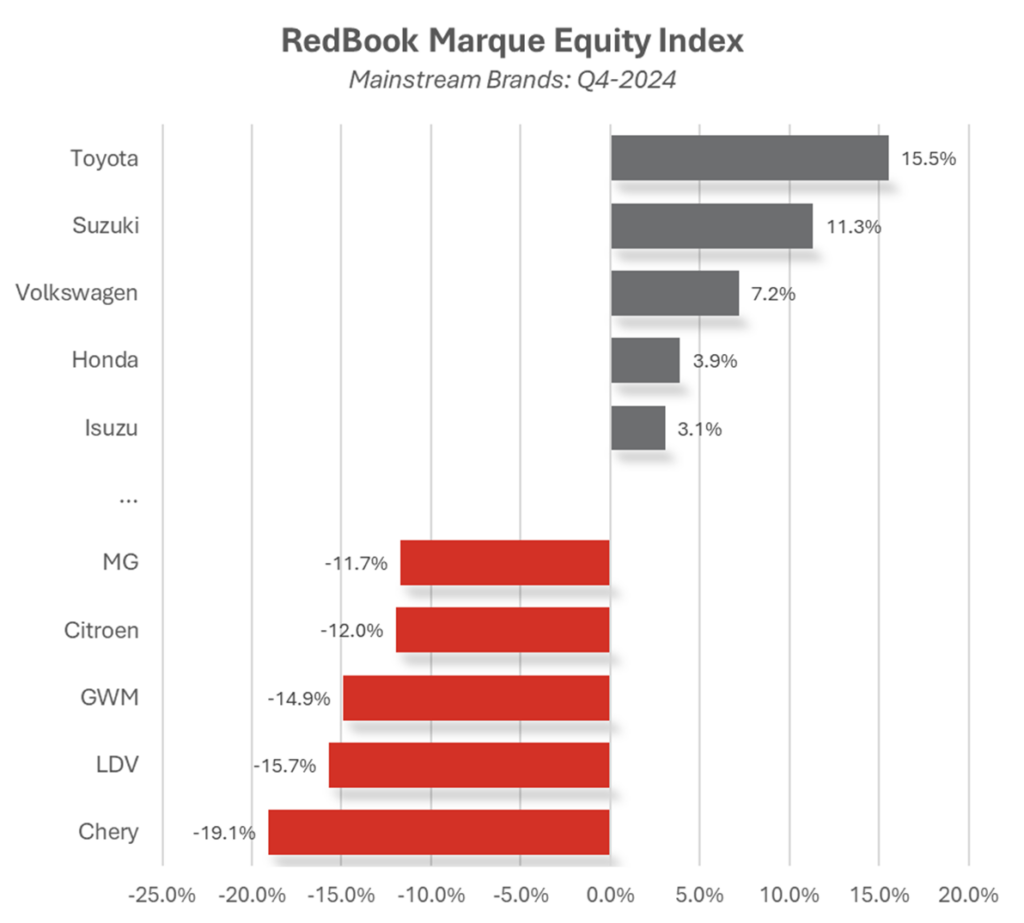
The Marque Equity Index provides valuable insight into how brands are positioned in the used car market. While a negative index value suggests a challenge in resale strength, a positive value reflects a brand’s robust market presence and its vehicles’ ability to retain value. This reinforces the critical role of consumer perception and brand reputation in shaping market dynamics.
With Toyota continuing to perform well in the market, other manufacturers should consider how their brands meet Australian consumers’ expectations for reliability and resale value. Thanks to their strong reputations and market positioning, these top brands might offer safer investment opportunities for banks and insurers.
The data highlights a dynamic market in which established brands benefit from their long-standing reputations. In contrast, newer or less established players face a more challenging battle to gain traction. These trends underline the importance of sustained consumer confidence and adaptability to market demands.
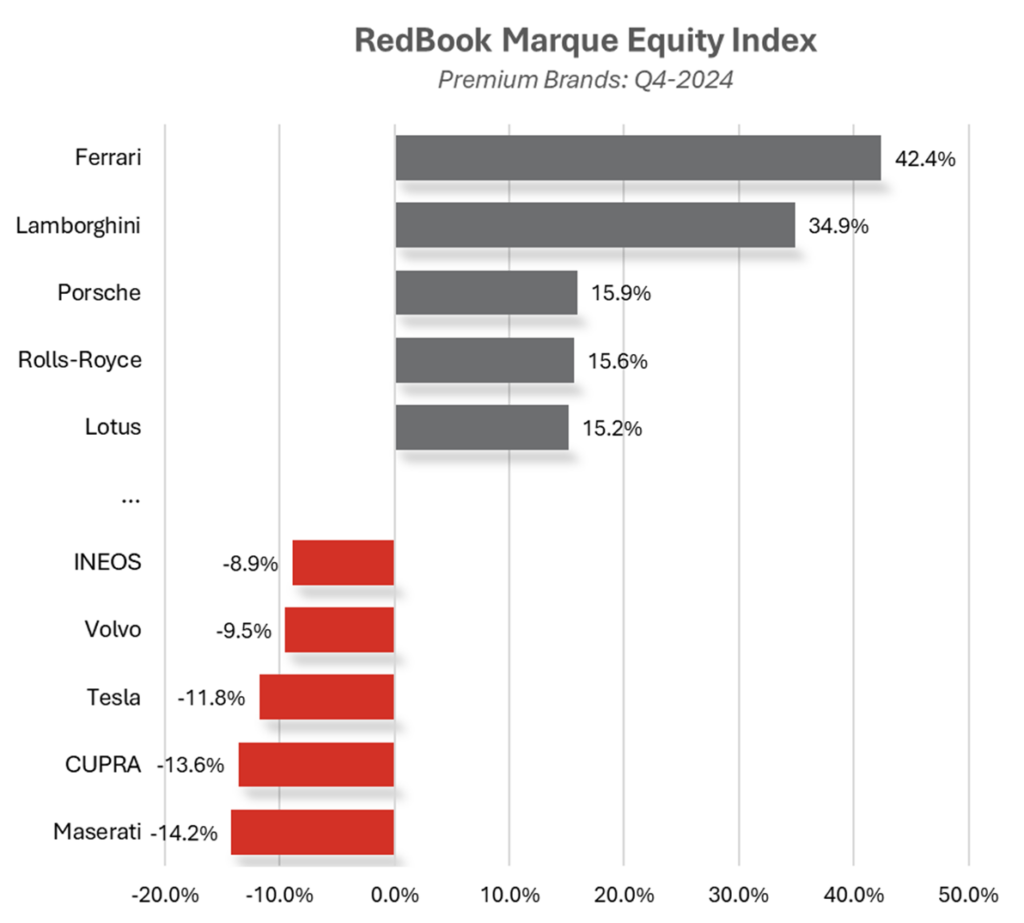
The Marque Equity Index for premium brands demonstrates the diverse factors shaping consumer perceptions and resale value in this segment. At the top, Ferrari and Lamborghini stand out with the highest scores, reflecting the timeless allure of their craftsmanship, heritage, and exclusivity. These brands hold their value exceptionally well and benefit from strong global demand, limited production runs, and a dedicated customer base that prizes prestige and performance.
Porsche and Rolls-Royce also rank highly, demonstrating the value of consistent brand identity and quality. Porsche’s enduring reputation for combining luxury with sportiness and robust demand across multiple models cements its position.
At the lower end of the premium spectrum, Maserati, CUPRA, and Tesla face challenges reflected in their lower MEI scores. Despite its rich history, Maserati may struggle with a fragmented brand perception and a lack of differentiation in an increasingly competitive market. As a newer entrant, CUPRA is still carving out its identity in the premium space, which may impact its ability to command high resale values.
Tesla presents an interesting case. While it leads the electric vehicle revolution and enjoys strong brand recognition, factors such as rapid technological advancements, evolving model lineups, and high initial depreciation weigh its index score. The swift pace of innovation in EVs can make older models feel outdated, impacting their appeal in the used market.
Brands like Volvo and INEOS’ mid-range performance highlights the complexity of balancing innovation, reliability, and consumer trust in the premium segment.
These findings underscore critical considerations for automotive OEMs operating in the luxury market. Substantial brand equity, a clear value proposition, and an unwavering focus on quality and exclusivity remain key drivers of success. Meanwhile, financial institutions and insurers can leverage this data better to assess risk and opportunity within the premium segment, identifying brands that offer stability and long-term value in a dynamic marketplace.
These trends underscore the premium segment’s unique pressures, where exclusivity, innovation, and brand heritage are critical to maintaining value. The data highlights the importance of balancing aspirational appeal with tangible resale strength to sustain long-term market positioning.
The Marque Equity Index extends beyond brand-level analysis, offering insights at a VFACTs segment level to provide a more granular understanding of relative performance. By assessing individual models within their respective segments, MEI highlights the comparative strength of vehicles across categories such as small SUVs, light cars, or luxury sedans. This allows stakeholders to pinpoint the standout performers in each segment and uncover valuable trends shaping the marketplace. Whether evaluating consumer preferences or guiding product planning, MEI at the segment level delivers a sharper lens for analyzing the competitive landscape.
For example, the SUV Light segment stands out for its compact design and versatile functionality blend, appealing to urban drivers and those seeking efficient yet stylish vehicles. Within this competitive space, the MEI highlights clear distinctions in performance, offering a deeper understanding of consumer preferences and market dynamics.
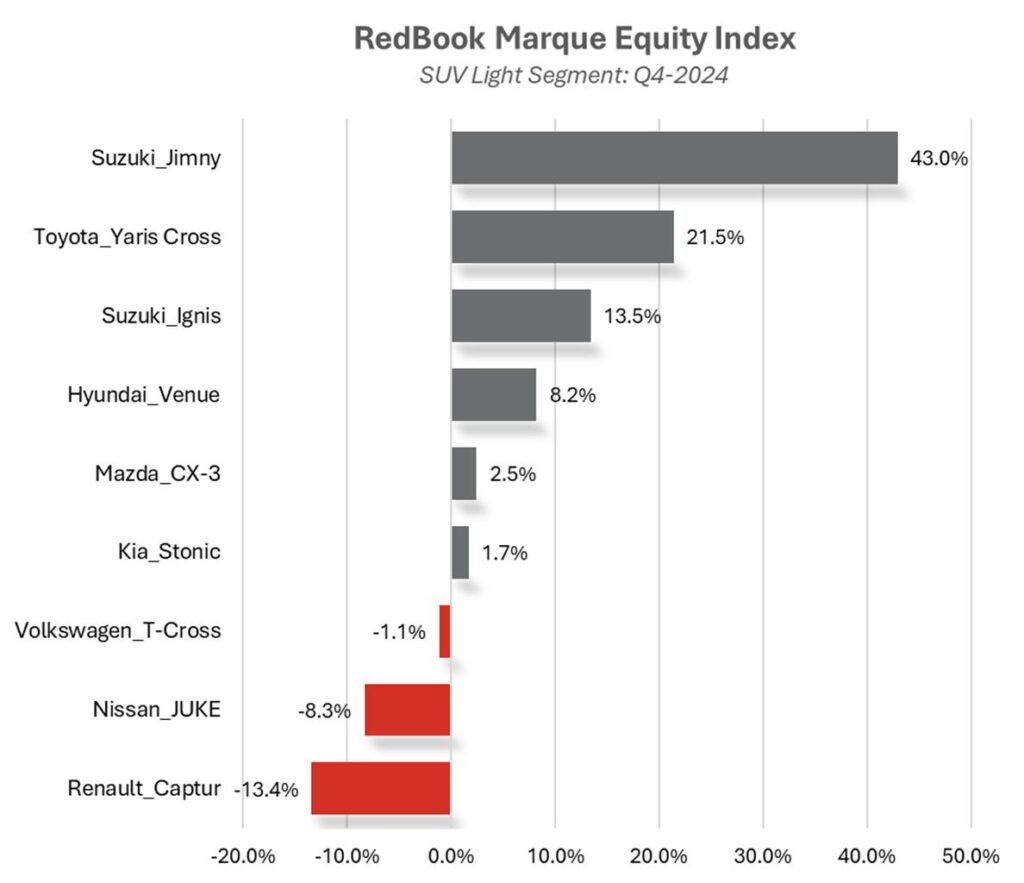
Suzuki Jimny dominates at the top of the chart with an impressive MEI of 43.0%, setting a high bar for the segment. Its enduring appeal lies in its iconic retro design and genuine off-road capability, a rare offering in this class. Limited supply has only amplified demand, ensuring its substantial resale value and underscoring its cult status.
Toyota Yaris Cross, with an MEI of 21.5%, exemplifies Toyota’s ability to blend reliability with modern, practical design. This crossover balances urban usability, and the features buyers expect from an SUV, making it a go-to choice for those who value durability and functionality.
The Suzuki Ignis follows closely with a 13.5% MEI. It leverages its quirky styling and affordability to maintain strong consumer interest. It captures a niche for buyers seeking something distinctive without breaking the bank, reinforcing its resale appeal.
Other notable performers include the Hyundai Venue (8.2%) and Mazda CX-3 (2.5%). Both models deliver on brand reputation and practicality, though fierce competition within this popular segment tempers their resale strength.
On the lower end of the spectrum, the Renault Captur (-13.4%) and Nissan Juke (-8.3%) struggle to match their competitors’ resale value strength. Challenges in consumer perception around reliability and a lack of standout features may impact their relative performance. Meanwhile, the Volkswagen T-Cross (-1.1%) shows promise but still lags slightly behind the top-tier performers in the segment.
These MEI results reflect the performance of individual models and offer actionable insights for manufacturers. Models like the Suzuki Jimny and Toyota Yaris Cross demonstrate the importance of aligning design, functionality, and brand perception with consumer expectations to secure a substantial resale value. For buyers, these metrics highlight the value retention of certain vehicles, offering clarity in an increasingly diverse market segment.
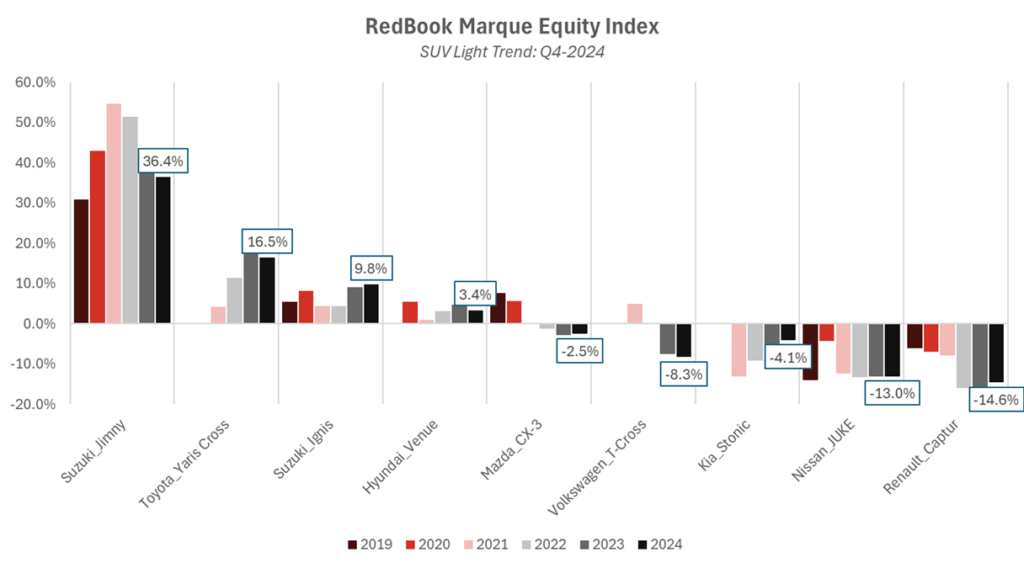
The SUV Light segment has experienced significant fluctuations in brand performance over the past five years, driven by evolving consumer preferences and competitive dynamics. The Marque Equity Index data highlights how specific models have successfully captured consumer demand while others have faced challenges maintaining their foothold. Here’s an analysis of key trends within the segment.
The Jimny, a segment leader for the past five years, owes its success to its distinctive off-road appeal and niche following. However, its MEI has softened recently as increased supply enters the market, slightly reducing its exclusivity-driven premiums. The Toyota Yaris Cross, despite being a newer entrant, has quickly established itself as a strong performer driven mainly by Toyota’s brand trust.
Mid-tier players like the Hyundai Venue and Suzuki Ignis have shown moderate success, maintaining steady MEI values through affordability and compact utility. However, these models face increasing pressure from stronger competitors, and their growth has plateaued in recent years. Meanwhile, legacy models like the Mazda CX-3 highlight the challenges of aging platforms and intensifying competition, as reflected in its declining MEI trend.
The lower-performing models, including the Volkswagen T-Cross, Renault Captur, and Nissan JUKE, show a consistent downward trajectory. These declines underscore the challenges of differentiating in a saturated market, particularly for brands with less established equity or polarizing designs. Negative MEIs across multiple years indicate persistent difficulty in sustaining consumer interest.
As we approach the end of 2024, brand perception and consumer loyalty will continue to drive vehicle pricing and brand value. With the rise of EVs, shifting market trends, and the enduring appeal of certain mainstream and premium brands, there are significant opportunities to refine strategies across OEMs, financial institutions, and other industry players.
To find out more or subscribe, contact us via info@redbook.com.au as we continue to track the ever-evolving landscape of the Australian automotive market.
Share this article:
Disclaimer:
The information presented in this article is true and correct at the time of publishing. business.carsales.com.au does not warrant or represent that the information is free from errors or omissions. The content is provided for informational purposes only and should not be construed as professional advice. For more details on our editorial standards and ethical guidelines, please visit our Editorial Guide Lines.