[et_pb_section fb_built=”1″ admin_label=”Section” _builder_version=”4.5.3″ _module_preset=”default” collapsed=”off”][et_pb_row _builder_version=”4.5.3″ _module_preset=”default” width=”100%” max_width=”1280px” collapsed=”off”][et_pb_column type=”4_4″ _builder_version=”4.5.3″ _module_preset=”default”][et_pb_divider show_divider=”off” admin_label=”Divider” _builder_version=”4.5.3″ _module_preset=”default”][/et_pb_divider][et_pb_post_title title=”off” featured_placement=”above” admin_label=”Post Title” _builder_version=”4.5.3″ _module_preset=”default”][/et_pb_post_title][et_pb_divider show_divider=”off” admin_label=”Divider” _builder_version=”4.5.3″ _module_preset=”default” custom_margin=”5px||||false|false”][/et_pb_divider][et_pb_text admin_label=”Text” _builder_version=”4.5.3″ _module_preset=”default” custom_padding=”||0px|||” hover_enabled=”0″]
Fast-growing Chinese auto brands and cars built in China by other global car-makers have played a major role in producing an all-time record for Australian new-vehicle sales in July.
From the new benchmark of 96,859 new vehicles sold across all countries of origin last month, Chinese-built vehicles accounted for 16.4 per cent of those (equivalent to 15,853 cars) – a massive upswing from the mere 0.37 per cent share (or 347 units) that cars from China contributed to the previous July record set in 2017.
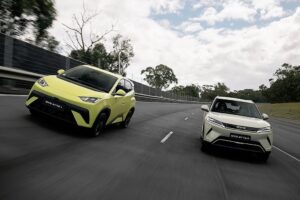
Figuring heavily in the latest results was the MG ZS small SUV, which placed third overall with 3852 sales – trailing only the dominant Ford Ranger (5143) and Toyota HiLux (4670) utes – and helped the Chinese brand to sixth position overall with 5347 sales (+77.2%).

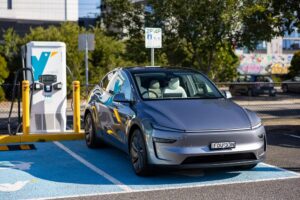
Tesla, which sells only Chinese-built electric vehicles in Australia, also played another significant role in the car industry’s recovery last month, racking up 3934 sales to hold eighth place as the Tesla Model Y (3330) took fourth among the nation’s top-selling cars.
Chinese brand GWM was just outside the top 10 with 2564 sales across its GWM, Haval and fledgling Tank and Ora sub-brands (+20.5%), while compatriot LDV also turned in another month of double-digit growth with 1374 sales (+12.8%).
Throw in 1005 sales of the BYD Atto 3 electric SUV, and 651 of the Chery Omoda 5 small SUV, and Australian buyers’ strong appetite for affordable and attainable new vehicles – many of them with a battery-electric powertrain – is bringing Chinese cars into play like never before.

This will only intensify as other new Chinese models and car-makers such as JAC, Nio, Zeekr and Lynk & Co head Down Under, and as global brands continue to shift production to China.
For now, China holds third position as the most favoured country of origin for new vehicles in Australia, behind Japan and the global ute production hub of Thailand.
For the year to date, 111,705 sales have come from China (+97.6%), compared to 183,385 from Japan (-7.5%), 142,386 from Thailand (-1.5%) and 96,467 from Korea in fourth (+1.2%).
The broader view
China’s current influence on Australia’s new-vehicle market must be tempered against restricted supplies and long delivery delays still being managed by other leading car-makers from Japan, South Korea and Europe.
The record July result reflects the long-awaited fulfilment of orders placed many months ago, pointing more to a normalisation and ongoing slow turnaround across an industry racked by COVID-related factory shutdowns, computer chip shortages and logistics, shipping and quarantine bottlenecks.
Acknowledging these roadblocks when announcing the sales data today, Federal Chamber of Automotive Industries (FCAI) CEO Tony Weber said: “During the past 12 months the issue has been one of securing supply for consumers, however as these pressures ease we are starting to see a return to more stable market conditions.
“Many of these vehicles were ordered several months ago, so it is important to monitor the broader economic conditions through 2023 and their impact on private and business demand.”

At the top of the pile, Toyota delivered 19,191 new vehicles in July, which was down 1.9 per cent on last year but a solid performance nonetheless by the market leader that’s now on the comeback trail after suffering a 24 per cent downturn in the first half.
Toyota has shifted into a higher gear as supplies improve, and last month HiLux was joined in the best-sellers’ list by RAV4 (fifth, 2750), Corolla (sixth, 2145) and Prado (ninth, 1836), which remains a perennial favourite even as an all-new model coming in 2024 attracts huge attention.
Mazda held its accustomed second place with 8307 sales last month (+5.4%), despite not having any cars among the top 10. Instead, it had consistently strong sales of around 1500 units across its CX-3, CX-30 and CX-5 SUVs, with the all-new CX-60 (628) making an early impact in its first month on sale.

Ford rounded out the top three with 7109 sales – almost three-quarters (72.3%) of those going to the Ranger ute – while Hyundai (6521, -4.0%) and Kia (6150, -8.4%) were tight in fourth and fifth place respectively.
Note the negative monthly returns here for the two leading Korean brands, also keenly felt by Mitsubishi (4143, -26.2%) as it found itself in seventh place behind MG (5347, +77.2%) and just in front of Tesla (3934, +>999%). Its best performer was Outlander in 10th (1778).

Rounding out the top 10 was Subaru in ninth (3553, +25.9%) and Isuzu Ute (3340, +21,5%) in 10th, while other major brands knocking on the door were Volkswagen (2968, +46.8%), Nissan (2399, +9.6%) and, as previously mentioned, GWM (2564, +20.5%).
Key market trends continued in July, with SUVs accounting for 58.9 per cent of total new vehicle sales (57,003, +27.5%), at the expense of passenger cars on 17.7 per cent (17,156, +6.9%). Light commercials (including utes) accounted for 19.9 per cent of all sales (19,244, -4.0%).
Mid-size SUV was the dominant segment with 22,000 sales, ahead of utes on 17,218 and small SUVs on 16,310.
There were 6846 electric vehicle sales recorded in July, accounting for 7.0 per cent of the industry total and taking the year-to-date EV running balance to 49,938 units – up 385 per cent compared to the same point last year.

Top 10 brands (2023 year to date):
- Toyota – 111,426
- Mazda – 58,731
- Kia – 45,310
- Ford – 45,290
- Hyundai – 44,228
- Mitsubishi – 34,992
- MG – 32,039
- Tesla – 29,511
- Subaru – 26,055
- Volkswagen – 23,938
Top 10 vehicles (July 2023):
- Ford Ranger – 5143
- Toyota HiLux – 4670
- MG ZS – 3852
- Tesla Model Y – 3330
- Toyota RAV4 – 2750
- Toyota Corolla – 2145
- Isuzu D-MAX – 2070
- Hyundai i30 – 1865
- Toyota Prado – 1836
- Mitsubishi Outlander – 1778
This article originally appeared on carsales.com.au
[/et_pb_text][/et_pb_column][/et_pb_row][/et_pb_section]