The shift to Electric Vehicles (EVs) is rapidly taking place across the world – with implications for Australian car brands, dealers and consumers.
Catch up on all the Electric Vehicle industry news and insights you auto to know about:
1. BYD to launch three sub-$35K EVs in Australia soon
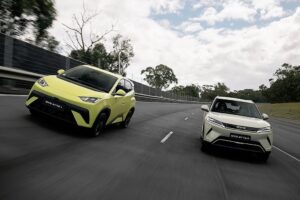
The Australian distributor for Chinese EV brand BYD says it will deliver three sub-$35,000 vehicles to market over the next nine months, in what is being described as a breakthrough moment for the electric vehicle movement in this country.
TrueGreen Mobility, which has launched a “direct to consumer” model with BYD in Australia, says it will deliver an electric hatch and SUV priced below $35,000 that deliver a driving range of about 500km.
2. Ford Australia’s first Electric Vehicle firms
Ford Australia is fast closing in on its first Electric Vehicle – and there will be more than one.
The blue oval brand is keeping exact details a closely guarded secret, but the smart money is on the Ford Mustang Mach-E with a local plug-in date early in 2022.
3. $3000 subsidy to spark up Victorian EV sales
The Victorian Government has announced a subsidy to boost adoption of Zero Emissions Vehicles, including EVs, as it seeks to grow sales to 50% of new cars by 2030.
More than 20,000 subsidies are available under the program. The subsidies will be offered in three rounds until the rebates are fully committed, or for three years – whichever occurs first.
The first round of the plan includes 4000 subsidies of $3000. The value of subsequent stages is yet to be finalised.
4. Victoria locks in controversial EV tax
Electric vehicle owners in Victoria will pay 2.5 cents for every kilometre travelled with effect from July 1, following the formal implementation of a new EV tax by the Andrews government.
Despite the efforts of the Greens to have the legislation blocked, the bill passed through the upper house of state Parliament this week with the support of cross-bench MPs.
The tax is anticipated to raise $30 million over four years for state government coffers and will cost the average EV owner between $260 and $300 a year.
5. What the world is doing to fast-forward Electric Vehicles
The world is changing, and charging towards a future filled with Electric Vehicles, as a result of government intervention.
With climate change dictating policies in parliaments across the globe to prevent major urban areas from being choked by pollution, car-makers are being forced to fast-forward plans to develop and sell zero-emissions vehicles in order for them to stay in business.
Some countries have already set ambitious targets to slash carbon-based emissions including abolishing the sale of petrol- or diesel-powered vehicles by a certain date, while others – including Australia – are still tippy-toeing around the topic so as not to upset major industries like mining and transport.
6. Six new Electric Vehicles coming to Australia this year
The onslaught of Electric Vehicles heading our way is rapidly gathering pace, and a variety of all-new EVs will be seen in Australian showrooms before the end of 2021.
These will be electric vehicles from mainstream and premium brands alike, and some car companies are already taking orders as interest and demand builds up in the marketplace.
7. Combustion engines facing early retirement
Following the lead of General Motors, Volvo and other global car-makers, the Hyundai Motor Group has reportedly halved its R&D budgets for internal combustion engines (ICE) and is seeking to fully electrify its vehicle range by 2040.
Impending Euro 7 emissions regulations are forcing the hands of many car-makers, with reports that the new legislation could kill off petrol and diesel engines from EU marketplaces by 2026, sending shockwaves through the automotive industry.
8. Electric vehicle interest in Australia charges up
carsales data highlights a significant lift in views and enquiries for hybrid and Electric Vehicles during 2020.
9. Tesla dominates Australian EV sales
Tesla imported more battery Electric Vehicles into Australia in 2020 than all other brands combined.
Despite production challenges at its Fremont, California plant in mid-2020, figures obtained by carsales confirm Tesla shipped 2949 vehicles to Australia in 2020 and over 2600 of them were the mid-size Model 3 sedan.
10. Why 2021 will finally be the year for EVs (according to Behavioural Science)
It’s easy to point to the obvious, tangible factors as making all the difference. Regulatory changes, better incentives, and lower prices are all important ingredients that will help Electric Vehicles ‘tip’ into the middle, and each of these is moving in the right direction.
As important as these sorts of initiatives are, they can distract us from a far bigger, far more influential factor at play….