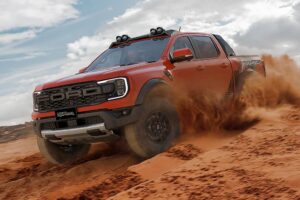
The Toyota HiLux and Ford Ranger continued their battle for supremacy last month among the top-selling new vehicles in Australia, but the concern is mounting that supplies across the industry will be severely impacted for the remainder of the year, dragging the entire market down to below pre-pandemic levels.
COVID lockdowns, flareups and ongoing restrictions in key markets such as Sydney, Melbourne and Brisbane are compounding the problem, but it’s reduced production at factories overseas due to a global semi-conductor shortage and other issues that threaten to undo the sales gains made in the first half of the year.
The Federal Chamber of Automotive Industries (FCAI) is putting a positive spin on the latest results, which show 84,161 new car sales were made in July, up 16.1 per cent on the corresponding month last year – but only 1.2 per cent ahead of July 2019.
For the year to date, the industry is 26.5 per cent up on 2020, but just 2.2 per cent ahead compared to the year prior.
“Growth of 16.1 per cent shows the underlying strength, confidence and resilience in the market in spite of the challenges being presented due to lockdowns and ongoing delivery issues caused by microprocessor shortages and shipping delays,” said FCAI chief executive Tony Weber.
The top-selling Toyota HiLux and Ford Ranger posted 4610 and 4064 sales respectively last month, but COVID-related shutdowns currently impacting Toyota production facilities in Thailand could threaten HiLux (and Fortuner) supplies to Australia in the months ahead.
“Toyota Australia is currently assessing any impact that the current COVID-19 restrictions in Thailand will have on the HiLux and Fortuner lines,” a spokesperson told carsales today. “We will provide an update in due course.”
Ford recently told carsales that it was expecting to have “a good supply” of its Thai-built Ranger (and Everest) “throughout at least the third quarter” but that the company was “continuing to work with our global teams on meeting our ongoing demand”.
So despite huge demand across the industry, particularly for utes and SUVs, the second half of the year could see new vehicle sales weaken considerably for many of the leading brands – and provide a windfall for those that do have plenty of supplies, such as some Chinese car-makers.
Perhaps ominously, there was no sign of the Nissan Navara or Mitsubishi Triton in the list of top 10 models last month, with the only other ute being the Isuzu D-MAX (2427) in fourth place.
The Toyota Corolla split the ute parade with third place and the Mazda CX-5 rounded out the top five, followed by Toyota’s RAV4 and Prado.
Together with HiLux, Toyota’s top-selling nameplates underlined Brand T’s dominance that handed it a 21 per cent market share and 17,643 total sales last month.
Mazda was next best with 8919 sales, followed by an incredibly tight four-way battle between Ford (5569), Mitsubishi (5302), Kia (5202), and Hyundai (5062).
Honda, in its first full month under a new ‘agency’ sales structure that has pared back its line-up and applies fixed vehicle pricing nationwide, sold 822 cars.
For the former top 10 brand, that was only good enough for 19th position, but sales volume is no longer the prime focus for the brand. A spokesperson told carsales today that “quantity of sales is not the measure of success for us now … it’s about the customer experience”.
He also said there was no traditional order bank with the transition to the new business structure, and that the company was effectively taking orders from customers on July 1 from a “zero base”.
Epitomising the ongoing growth of Chinese car-makers in Australia, GWM Australia racked up 2011 sales last month on the back of its new Haval Jolion and Haval H6 SUVs and the GWM Ute.
For the year to date, GWM has piled on 9575 sales, up 268 per cent over last year – when it was still trading well during the severe early waves of the pandemic.
Among the volume-selling premium brands, Mercedes-Benz managed 2385 sales in July amid supply restrictions and related specification downgrades, which placed it ahead of BMW on 1814 units and Audi on 1371.
The new DT-series RAM 1500 pick-up truck – flexing its considerable muscle in our comparison test with the Chevrolet Silverado today – has also continued its strong form on the sales charts, posting 324 sales last month to take it beyond 2200 for the year.
There were 515 electric cars sold last month, which according to the FCAI reflects strong demand in Victoria and NSW where state governments have introduced incentives for buyers.
But without Tesla sales included in the figures, the EV total is hugely understated.
An FCAI spokesperson told carsales today: “The industry and journalists find it [VFACTS data] useful sans the Tesla data and … the figures are a good indication of growth regardless. We’re cognisant of the missing data though.”
Almost 7600 Tesla vehicles have been sold in Australia so far this year according to carsales sources, accounting for nearly half of all Teslas delivered Down Under since 2014.
And while only 515 EVs were officially registered in total last month, no fewer than 1245 Tesla Model 3 cars were sold in July.
There were also 325 plug-in hybrids and 5152 regular hybrids sold last month.
Top 10 brands (2021 year to date):
Toyota – 136,596
Mazda – 69,365
Hyundai – 43,696
Ford – 43,452
Kia – 43,096
Mitsubishi – 42,745
Nissan – 26,673
Volkswagen – 24,731
MG – 22,857
Subaru – 22,469
Top 10 models (July 2021):
Toyota HiLux – 4610
Ford Ranger – 4064
Toyota Corolla – 2535
Isuzu D-MAX – 2427
Mazda CX-5 – 2389
Toyota RAV4 – 2345
Toyota Prado – 2251
Hyundai i30 – 1914
Mitsubishi Outlander – 1792
MG ZS – 1786
Catch up on recent VFACTS new car sales reports
December 2020 | January 2021| February 2021 | March 2021 | April 2021 | May 2021 | June 2021