Unsatisfied demand and production delays… but the market continues to grow
Carsales has again taken the pulse of several mass market and prestige manufacturers, as COVID-19 restrictions and semi-conductor delays continue to cause a double dose of restricted trading. With demand ramping up and the most recent VFACTS report showing increasing sales momentum, this latest update follows our July report – when the semi-conductor delays were at the forefront.
Mass Movement
Toyota’s 220,000 target
In a recent update to carsales, a Toyota spokesperson confirmed the brand’s ongoing strength. “Toyota has had strong supply this year, which has enabled us to achieve the best nine months in sales since the all-time record year of 2008.
“We are expecting full-year sales exceeding 220,000 vehicles, compared with just under 205,000 in 2020.”
Despite the impressive raw numbers, the spokesperson conceded that RAV4 Hybrid and LandCruiser 70 Series are experiencing 9-10 month wait times. The new LandCruiser 300 Series will also be impacted by ongoing production delays.
Supply limitations continue to constrain at Ford
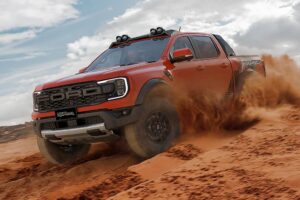
While the Ranger led the market sales race in September, Ford has acknowledged that supply is tightening and waiting times for certain Ranger and Everest grades have ballooned into early-2022. “We are continuing to work with our global teams on meeting our ongoing demand,” a Ford spokesperson said.
“The Escape Medium SUV and Transit Commercial range are also experiencing limited supply, with early-2022 deliveries now expected on new orders. Though there is current limited Mustang stock, Ford also advised there is delay on some variants, with an early-2022 ETA. Supply is also tightening for Puma, though there is currently available showroom stock.
“We recommend that customers check with their local Ford dealer to see what vehicles are available,” Ford said.
Honda hopeful
The well-publicised shift to an agency model earlier this year – and the resulting angst created among some key dealers in the network – has created another 2021 headache for the Japanese brand. Lower sales have been realised through this distribution model shift, though the positive is there is higher available stock COVID-affected states.
“Stock levels are greater in the main COVID-affected states of Victoria and New South Wales, as lockdown restrictions have had an impact on new vehicle sales in those areas,” a Honda Australia spokesperson said.
Nation-wide, Honda doesn’t “envisage any major supply disruptions over the next few months, however the COVID-19 pandemic and global semi-conductor parts shortage both continue to have an impact across the automotive industry and the situation remains fluid.
“At present we have available stock of CR-V and HR-V models, along with Accord and Odyssey, while current Civic hatch is now in run-out, so stock is limited ahead of the all-new Civic hatch arriving in mid-November,” they said.
Prestige Plays
Audi ‘satisfied’
At the premium end, the story is similar, with acknowledged strong demand countered by supply restrictions and locked-down regions. An Audi spokesperson advised: “Stock is generally in good position now, sufficient to meet our planned sales volumes.
“Customer demand remains very strong despite the impact of the pandemic, so we are holding less stock than usual.
We are able to meet most orders within a reasonable timeframe and there is in-dealer stock available for most models,” they said, adding that the tighter stock levels will remain in play until 2022 should demand remain constant.
The demand situation is amplified with RS performance models, which are “subject to longer production waiting periods” and Audi acknowledged that certain vehicle equipment is suffering from occasional production delays.
“When this occurs, we offer customers a choice… to forego the item and be compensated for the cost, or to wait until the item is available again,” they explained.
As a result of the current state-of-pay, Audi has delayed launch of the new A3, S3 and e-tron GT until 2022. “We still expect to achieve our year-on-year growth ambitions in 2021, despite the challenges, and so we are satisfied with our sales volumes,” the spokesperson said.
A range in demand, delays ‘weeks rather than months’: Mercedes-Benz
Mercedes-Benz, meanwhile, appears keener to mould to the demands of the day… a spokesperson saying, “Supply forecast is changing on a regular basis.”
“Demand is certainly outstripping supply with demand strong across the entire range. For the near future at least, this is our normal stock situation,” they said.
The brand has experienced some delivery delays, but stated these were “nothing significant, weeks rather than months, as these were related to lockdowns.”
The spokesperson acknowledged that “some vehicles have features omitted from the standard specification due to the semi-conductor shortage. As this is order specific and based on timing of production, customers can discuss this with their local retailer to see how this may affect their order.”
Overall market weathering the storm
Bearing out the OEMs’ general sentiment, the market is showing resilience in the face of these challenges and carsales’ research indicates the demand to buy now is higher than at any other time over the last 18 months.. The September 2021 VFACTS data shows the industry is running 0.6 per cent ahead of the non-impacted September 2019 year-to-date figure, and 20 per cent ahead of September 2020’s year-to-date. Total sales through the first three-quarters of calendar 2021 sit at 816,140. Will the magic million be hit by December? Only time will tell