The hidden moments shaping the new car buying journey

News
4 min read
Share this article:
News
4 min read

By the time a new car buyer visits a dealership, the decision is nearly made. Here is what our research says you can still do to influence it.

Most new car buyers walk onto your floor looking like they’re still shopping around. They’re not. By the time they get there, the decision is nearly made. 

To understand what is really happening between first search and final decision, we recently looked at new car buyers specifically, drawing on Australia’s Car Buyer Report alongside recent consumer sentiment research into how buyers are using AI and how they feel about EVs. Together, they paint a clearer picture of a journey that now happens largely out of view, and it matters because every stage of that journey is now a chance to win a buyer over, or lose them, well before they reach the showroom floor. 

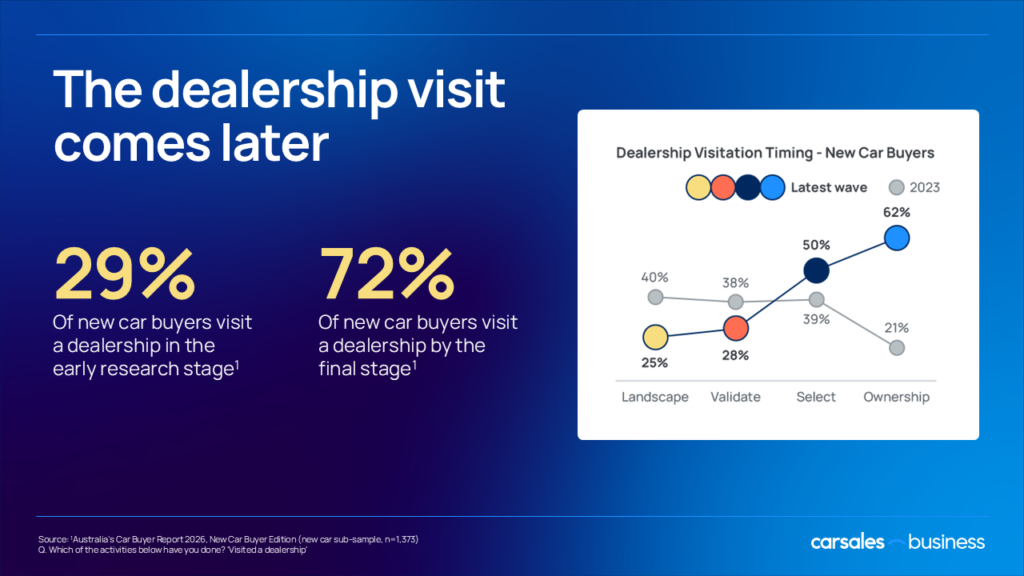
Only 25% of new car buyers set foot in a dealership during early research,1 and most of that research now happens where brands and dealers can’t see it: comparing models, reading reviews, narrowing a shortlist, all before anyone makes contact or shows up in person. By the time 62% do visit a dealership, they are close to a decision, not shopping for one.¹ 

The role of AI


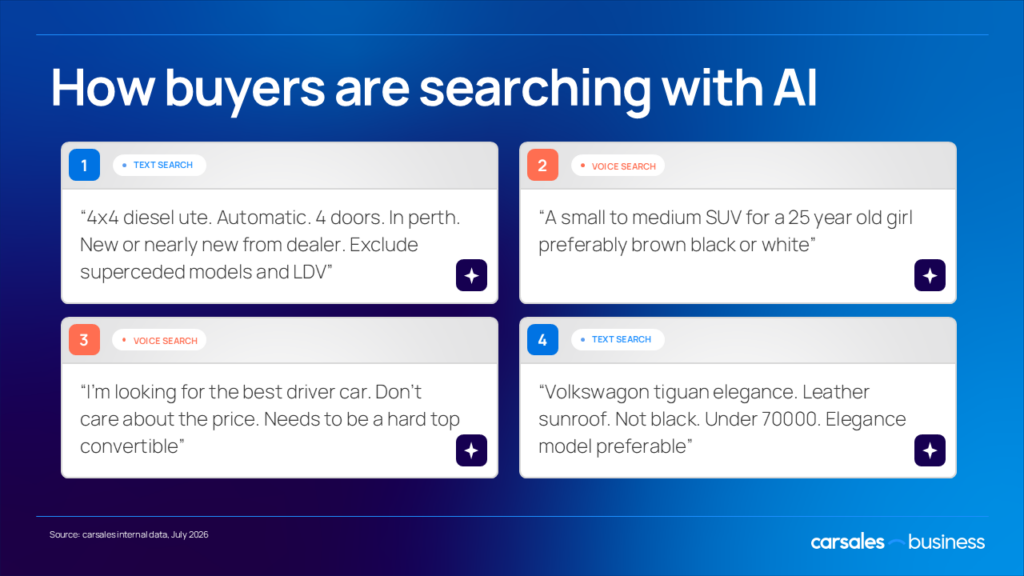
AI has quietly become a larger part of that research. More than half of AI users now use it to compare vehicles and listings,² often in plain language, for example “I want a small SUV under budget, leather seats, only in brown or black”. That shift matters for how discoverable your inventory is. A listing built around make, model and trim alone is easy to miss when buyers are searching in full sentences. It also matters because of where those AI searches tend to land: carsales holds 55% of AI chatbot traffic across the competitor set, more than three times the next closest site.3 In practice, that means a buyer comparing cars through AI is more likely to be pointed to carsales, and to your listing, than anywhere else.

AI is changing more than how buyers search, it is changing who gets on the shortlist in the first place. It is putting brands in front of buyers who would never have gone looking for them, widening the shortlist to include names they would have dismissed a few years ago.4 That holds true even for EVs, where consideration keeps growing. But an easier path onto the shortlist is not the same as an easier path to the sale. Most buyers considering an EV still want to buy it through a dealer.5 Familiarity might be shifting, but the need for a trusted human to back the decision has not.


What turns buyers away


So what actually separates the dealers who turn that research into a sale, and the ones who lose the buyer somewhere along the way? Buyers on carsales point to pressure to sign today, follow-up that feels relentless and inventory that does not match what was advertised as the main reasons they walk. What draws them in is the opposite: clear pricing, being treated well and confidence that after-sales support will hold up.6 Enough buyers value that treatment that they would happily pay slightly more to get it.7

The road ahead

While there are many levers your dealership can pull, here are three things worth doing on the floor, and before a buyer ever gets there. 

Make listings searchable the way people actually search. Go beyond make, model and trim, describe the car the way a buyer would ask an AI to find it, because that is increasingly how the shortlist gets built. 

Respond fast, and respond straight. Buyers are backtracking and comparing right up until they commit, so the dealership that answers quickly and transparently, on price, on availability, on trade value, is the one still in the running when they decide. 

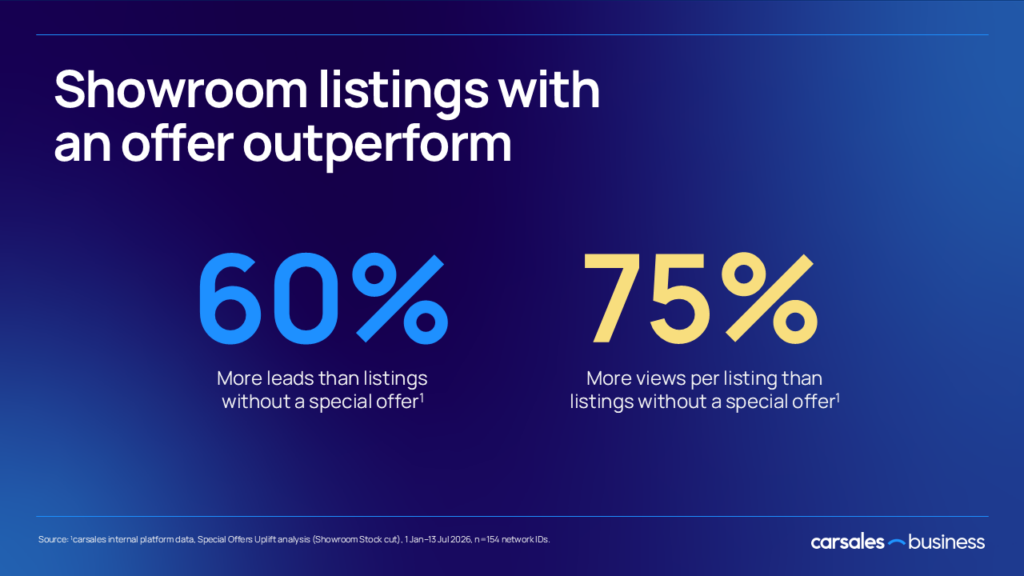
Make offers and after-sales support visible, not something buyers have to ask for. A special offer alone lifts enquiries by 60% and views by 75%.8 Clear warranty and trade-in terms do the quieter work of building trust before the enquiry even lands, and reinforcing it once the buyer is standing on the floor. 

None of this changes what has always worked on the floor. It just means the trust now has to be earned earlier, before anyone walks in.

Looking for more insights into how Australians buy cars? Download your copy of Australia’s Car Buyer Report 2026: New Car Buyer edition. 


Sources 
1 Australia’s Car Buyer Report 2026, New Car Buyer Edition (new car sub-sample, n=1,373) Q. Which of the activities below have you done? ‘Visited a dealership’ 
2 carsales AI in the Car buying Journey Survey, June  2026, n=390 Q. Which of the following do you plan to do with AI as you go through your car buying journey? 
3 Similarweb (AI Chatbot Traffic), Apr 2026 – Jun 2026 (does not include app traffic); Please note figures in the graph are rounded to the nearest 1,000. carsales compared to measured category competitors only (being CarsGuide, CarExpert, Drive and WhichCar) 
4 carsales Onsite Survey, June 2026, new car buyer sub-sample, n=615. Q Which brand or brands are you now considering that you wouldn’t have considered 3 to 5 years ago?  
5 carsales EV Consumer Survey, May 2026, n=463. How would you prefer to buy a new EV? Asked of non-owners who have considered an EV 
6 carsales Onsite Survey, June 2026, new car buyer sub-sample, n=615. Q ‘Imagine two dealers are offering the same car at a similar price. What would make you choose one dealer over the other?’. 
7 carsales Onsite Survey, June 2026, new car buyer sub-sample n=289 Q ‘Based on the selections to the above question, if a dealer offer those but charged slightly more for the same car, would you still choose that dealer?. 
8 carsales internal platform data, Special Offers Uplift analysis (Showroom Stock cut), 1 Jan–13 Jul 2026.

Share this article:

LinkedIn logo

carsales for Business

Disclaimer:
The information presented in this article is true and correct at the time of publishing. business.carsales.com.au does not warrant or represent that the information is free from errors or omissions. The content is provided for informational purposes only and should not be construed as professional advice. For more details on our editorial standards and ethical guidelines, please visit our Editorial Guide Lines.